
Free Soroban lessons for kids · No sign-up · Ages 5–12
Fun Abacus: Learn Abacus Online for Free
FunAbacus is a free online abacus learning website for children, parents, and teachers. Learn the Japanese Soroban through step-by-step lessons, interactive practice, printable worksheets, and games that make math visual, engaging, and approachable.
Everything You Need to Learn the Abacus
Free lessons and tutorials, printable manuals and worksheets, interactive practice tests and step-by-step Soroban techniques — all in one place.
- Step-by-step lessonsLearn the Soroban structure, finger technique and place value, then addition, subtraction, multiplication and division.
- Online Soroban boardA free virtual abacus that works on phones, tablets and computers — set numbers and check your answers.
- Practice testsGenerate timed quizzes and worksheets for every skill level to build speed and confidence.
- Printable worksheetsA printable beginner’s manual with complement tables and graded worksheets with answer keys.
- Soroban Challenge gameBeat the timer, keep your lives and try the daily challenge — practice that feels like play.
- Fun activitiesStory sums, puzzles and games that keep abacus practice lively at home and in class.
What Is the Soroban?
The Soroban is a Japanese version of the abacus — a centuries-old tool used for arithmetic calculations. Unlike calculators, the Soroban helps learners visualize numbers, understand place value, and develop mental math skills. It’s especially effective for children, turning abstract math into a hands-on experience.
How the Soroban Works
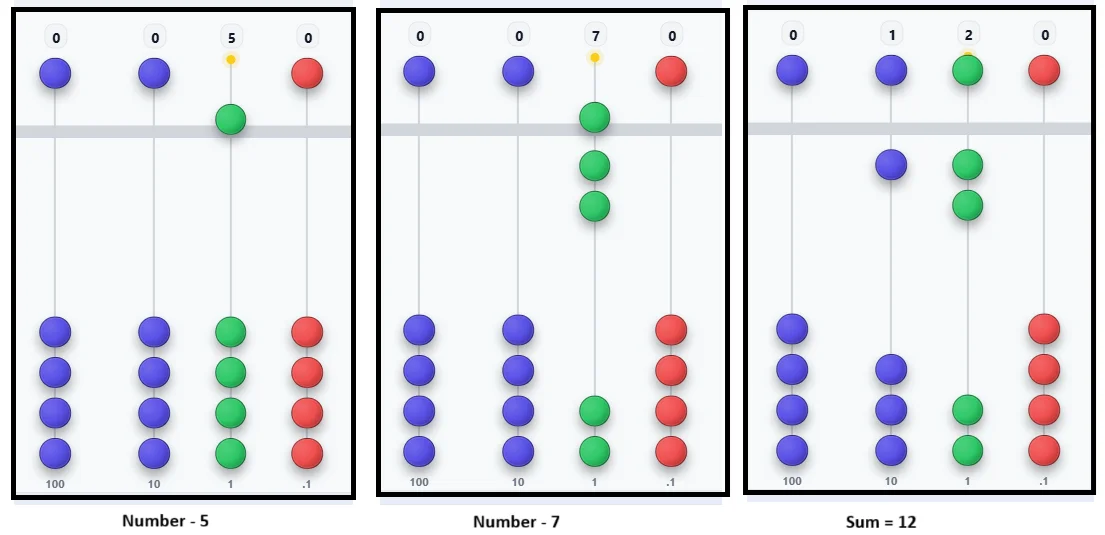
Each rod is one place value (ones, tens, hundreds). The single upper "heaven" bead is worth 5 and each of the four lower "earth" beads is worth 1. A bead counts when it is pushed toward the middle bar.
Example: 5 + 7 = 12
- Set 5: on the ones rod, move the heaven bead down to the bar.
- Think "+7 = +10 − 3": there are not enough beads to add 7 directly, so use the big friend of 7, which is 3.
- Take away 3 on the ones rod: 5 − 3 = 2, so move the heaven bead up and push two earth beads up with your thumb.
- Add 10: push one earth bead up on the tens rod.
- Read the answer: 1 ten and 2 ones — the board shows 12.
Your Learning Path on FunAbacus
Our three-step approach — Learn the structure and finger technique, Play with interactive examples and timed challenges, and Excel with complex problems and mental math (Anzan).
- Basics & finger techniqueParts of the Soroban, reading numbers, thumb and index finger.
- AdditionDirect addition, then small friends (5) and big friends (10).
- SubtractionBorrowing with the same friend numbers, left to right.
- Multiplication & divisionMulti-digit methods once adding and subtracting feel easy.
- Practice & mental mathTimed tests, then picturing the beads in your head (Anzan).
A Message from the Founder
“As a parent and lifelong learner, I’ve always believed that education should spark joy — not fear. A few years ago, I noticed my child struggling with basic math. Worksheets felt boring, numbers seemed confusing, and confidence was slipping away. I tried everything — flashcards, apps, games — but nothing truly clicked.
Then I discovered the Japanese abacus, or Soroban. It was simple, tactile, and surprisingly fun. My child loved moving the beads and watching numbers come to life. Within weeks, math became a game, not a chore.
That experience inspired me to create FunAbacus — a free, safe, and engaging platform where children, parents, and teachers can explore math through play. Whether you're just starting out or looking to sharpen skills, I invite you to explore, play, and grow with us.”
Why Kids Love the Abacus
Children often struggle with math because it feels abstract and intimidating. The abacus changes that by turning numbers into a game.
- Playful learning — bead movement feels like play.
- Visual math — numbers are represented physically.
- Confidence boost — kids solve problems quickly and proudly.
- Focus and memory — regular practice builds concentration and mental calculation.
Why Parents and Teachers Trust FunAbacus
- Safe — child-friendly, no accounts, no personal data from children.
- Educational — based on the standard Japanese Soroban method.
- Flexible — use it at home, in school, or on the go, on any device.
- Free — all lessons, tools and worksheets cost nothing.
The Power of Mental Math (Anzan)
Once learners master the Soroban, they can begin practicing Anzan, or mental abacus. This technique allows children to visualize the abacus in their minds, solving problems without physical beads — building faster calculation, concentration, and visualization skills.
History of the Abacus
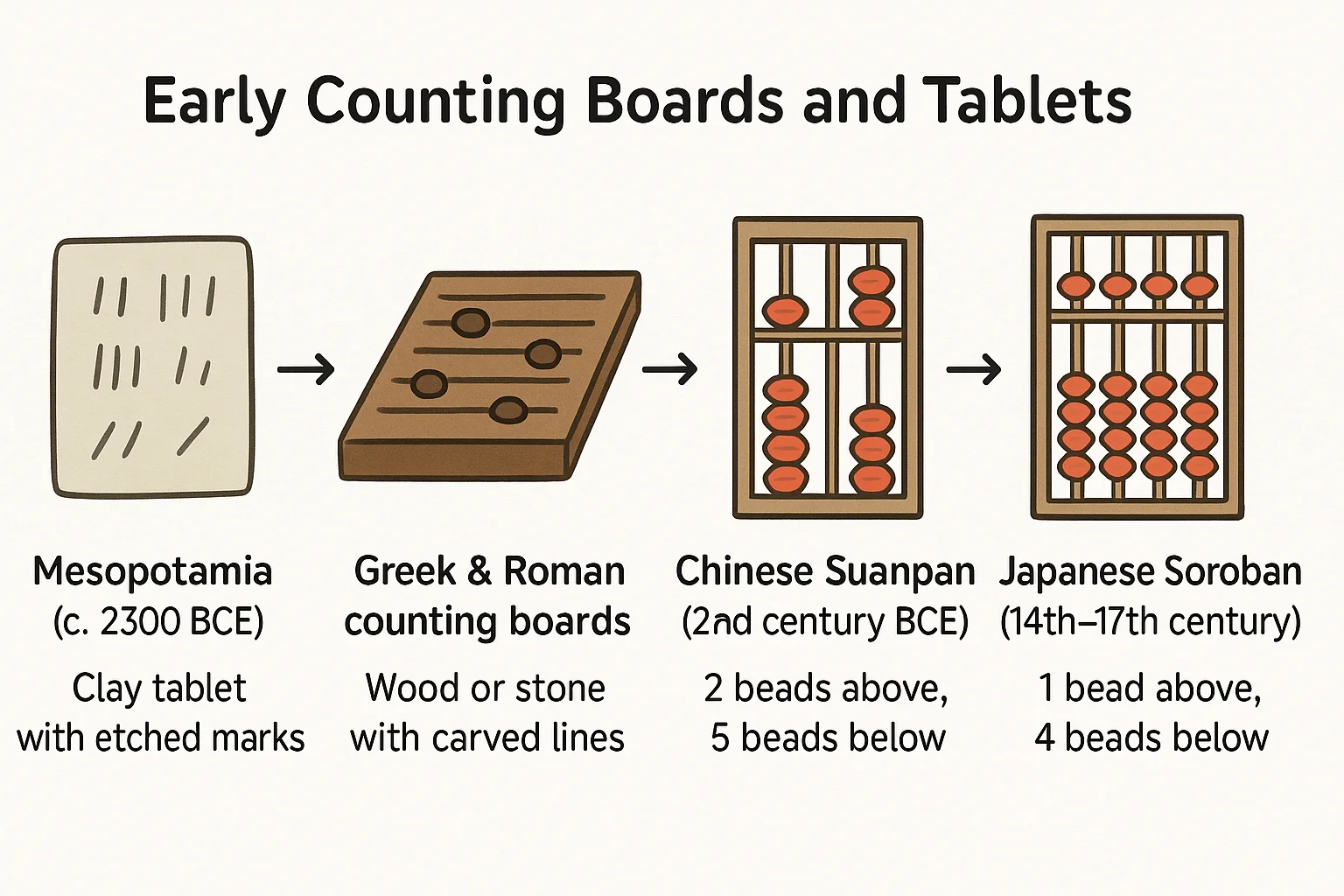
- Clay tablets — used in Mesopotamia for trade and accounting.
- Greek and Roman counting boards — pebbles moved along carved lines.
- Chinese Suanpan — two beads above and five below, for complex calculations.
- Japanese Soroban — one bead above and four below, a simplified design focused on speed and accuracy.
Explore more in our abacus references and further reading.
Frequently Asked Questions
What age can children start learning the abacus?
Most children can start around ages 5 to 6, once they recognise the numbers 0–9. Older children and adults can start at any time — the first lessons are the same for every beginner.
Is FunAbacus suitable for complete beginners?
Yes. Start with the Abacus Basics lesson, which explains the parts of the Soroban, how to read numbers and the correct finger technique, then follow the learning path through addition, subtraction, multiplication and division.
Do I need to buy a physical abacus?
No. You can learn with the free online Soroban board on any phone, tablet or computer. A physical Soroban is nice to have for daily practice, and our printable worksheets work with either.
What is the difference between an abacus and a Soroban?
The Soroban is the Japanese abacus. It has one bead worth 5 above the bar and four beads worth 1 below it on each rod, which makes it faster to use than the Chinese Suanpan with two upper and five lower beads.
How long does it take to learn the Soroban?
With about 10–15 minutes of practice a day, most children can add and subtract single- and two-digit numbers within a few weeks. Speed and mental math (Anzan) grow over months of regular practice.
Can teachers use FunAbacus in the classroom?
Yes. Teachers can project the online Soroban board, print the manual and worksheets, and generate practice tests for the whole class — all free for classroom use.
Is FunAbacus free and safe for children?
Yes. Everything is free, there are no accounts or sign-ups, and we never ask children for personal information. The site is supported by a small number of family-safe ads.
Ready to Begin Your Abacus Journey?
No registration required. Mathematics is more than numbers — it’s about curiosity, problem-solving, and confidence. Start today, one bead at a time.